
What the Latest Clinical Evidence Shows — and Why the Answer to Reverse Heart Disease Is More Powerful Than Most Doctors Realize
For decades, cardiovascular disease has been handled mostly like it’s a meds kind of problem— statins, beta-blockers, blood thinners. But more and more clinical proof is kind of turning that idea around, in a pretty convincing way. The science is now suggesting that what you eat, how you move around, your stress levels, and even your social connections aren’t just “helpful” in the background, no, they are actually treatment. In a lot of cases, these lifestyle inputs can even help reverse heart disease itself, which is honestly hard to ignore.
Cardiovascular disease keeps staying the top cause of death world wide , taking roughly 17–20 million lives every single year. Still the same research community that keeps writing those grim numbers is also turning out major discoveries about how, surprisingly, behavioral changes can be genuinely powerful. In this piece we go through the most solid clinical evidence that exists—and what it really means for anyone who’s been told their heart health is basically a one-way street, no exits.
The Landmark Trial That Changed Everything on reverse heart disease
Back in 1990, cardiologist Dr. Dean Ornish put out a randomized controlled trial that, honestly, kind of startled the medical community. People who already had confirmed coronary artery disease were put into two different paths, “a comprehensive lifestyle program” versus “usual care” which sounds simple but wasn’t really. The lifestyle side did a whole-food, plant-based diet, with less than 10% of calories from fat, plus moderate aerobic exercise, plus stress management techniques, plus they stopped smoking, and they also joined group social support meetings that felt, I guess, a little more than just advice.
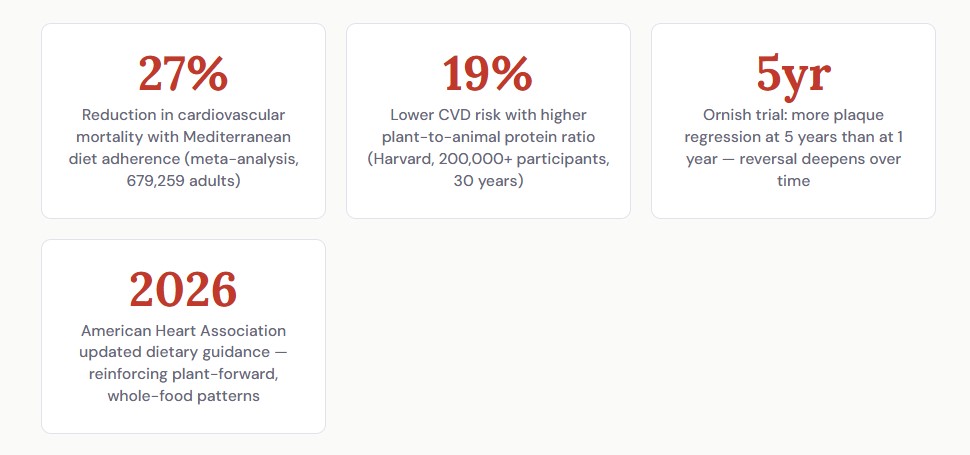
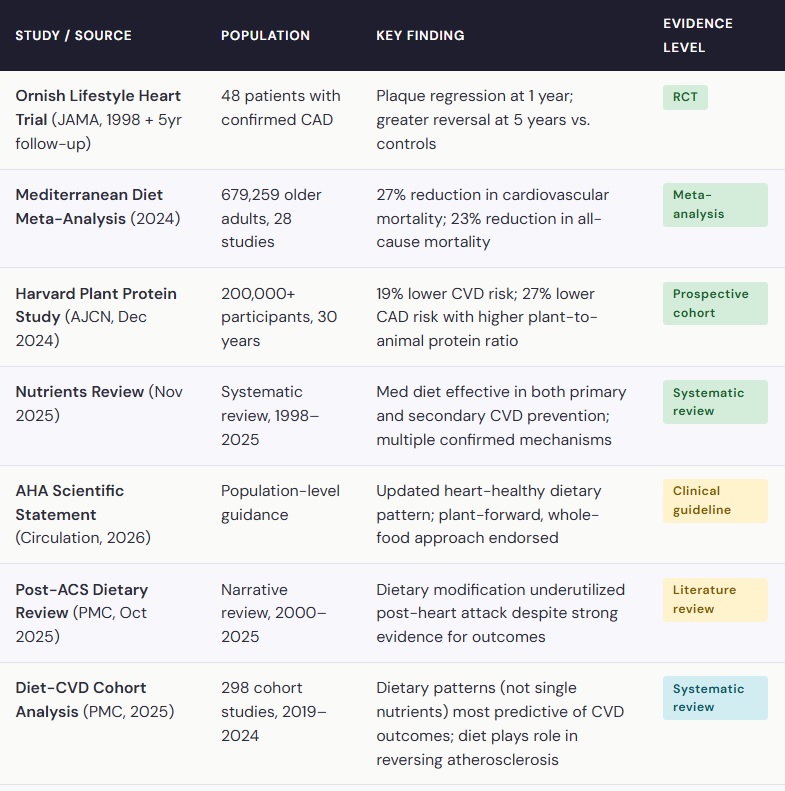
After about one year, the lifestyle group showed measurable regression of coronary artery plaque. In other words, the blockages in their arteries actually shrank, not just “slowed down” like people expected. Meanwhile the control group’s disease kept moving forward. Then there was the extra, almost hard to believe detail: a five-year follow-up in JAMA reported that the reverse heart disease seemed even stronger at five years than at the one-year mark. So, the longer patients held onto those lifestyle changes, the more their arteries improved, and it wasn’t just temporary either.
🔬 Clinical finding
The Ornish Program for Reversing Heart Disease remains the only lifestyle intervention program proven in peer-reviewed randomized controlled trials to reverse the progression of coronary artery disease. Recognizing this evidence, Medicare has covered the program since 2010 — an endorsement rarely given to lifestyle-based interventions.
This mechanism isnt mysterious really. Broad lifestyle adjustments can reduce plasma lipids, ease inflammation, bring down oxidative stress, and also enhance endothelial function — those exact biological tracks that fuel atherosclerosis. One review put it this way, dietary improvements can sometimes give lipid lowering effects comparable to statins in certain patients. And when lifestyle strategies are paired with statins, the benefits tend to stack up in an additive manner, not just a simple overlap.
What the 2025–2026 Research kind of confirms
The Ornish findings ar e no longer an outlier. You can feel the trend now, a wave of newer large-scale studies seems to converge on a shared conclusion: it is the overall dietary pattern not some single nutrient, that turns out to be the strongest lever for heart health. And honestly its impact looks like it can rival or even beat a lot of pharmacological interventions.
The Mediterranean Diet: A Robust, Replicable Effect
A 2024 meta-analysis, 28 studies with 679,259 older adults, showed that stronger adherence to a Mediterranean diet reduced all-cause mortality by 23% and cardiovascular-related mortality by 27%. Then in 2025, a review in Nutrients again supported the role of the Mediterranean diet for both primary prevention (stopping a first event) and secondary prevention (reducing recurrence after a heart attack or a procedure).
That review pointed to several converging mechanisms. Like lower LDL cholesterol and triglycerides, anti-inflammatory signals that come from polyphenols as well as omega-3 fatty acids, plus better endothelial function. And on top of that, it suggested changes that are favorable to the gut microbiome, which kind of ties in with the inflammation story
Plant-Based Protein: a 30-year Harvard look
A Harvard study released in December 2024, in The American Journal of Clinical Nutrition, followed more than 200,000 people for 30 years. People who ate more plant-based protein relative to animal protein showed a 19% lower risk of cardiovascular disease, and a 27% lower risk of coronary artery disease compared with those who ate more from animal sources.
This wasn’t some small, short-term check. It was one of the largest and longest dietary observational studies ever done, so the signal feels less shaky than it would in a quick snapshot.
The 2026 American Heart Association Statement
In March 2026, the American Heart Association updated it’s dietary guidance in a pretty broad scientific statement that was published in Circulation. The statement kinda reinforced a food pattern approach, more than the whole single-nutrient thing, and it kept highlighting: lots of vegetables and fruits with a wide variety, whole grains instead of refined grains, healthier plant based protein sources, unsaturated fats rather than saturated fats, and also minimal ultra processed foods and added sugars. That guidance is now backed by decades of cohort data, and some landmark trials too.
Summary of Key Clinical Evidences Show the Answer to Reverse Heart Disease
Beyond Diet: The Four Pillars of Lifestyle Medicine for Heart Health
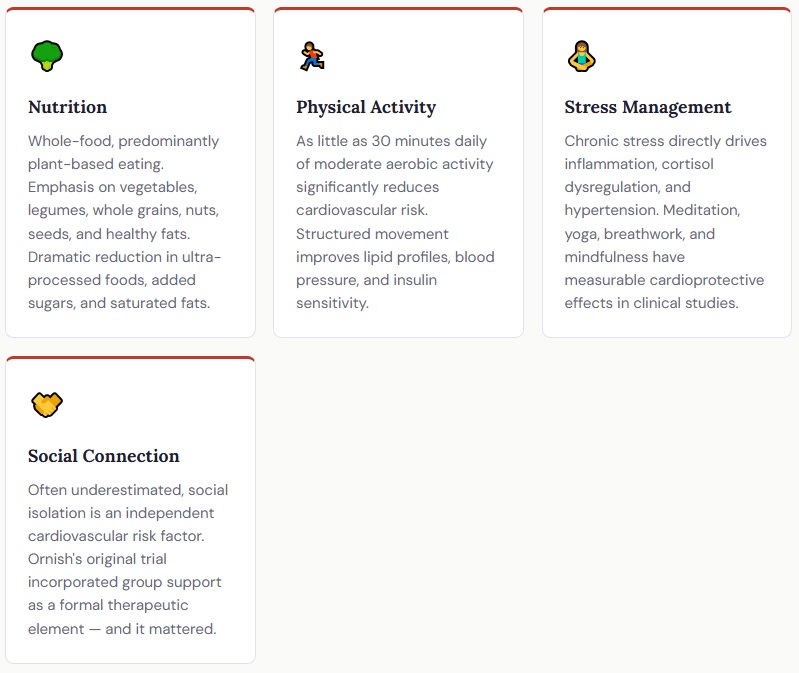
The evidence consistently shows that diet is most powerful when combined with the other pillars of lifestyle medicine. The Ornish program — and the broader field of lifestyle medicine — treats these as inseparable:
⚕️ Important clinical note
Lifestyle changes are not a replacement for medical care. If you have been diagnosed with heart disease, are on cardiac medications, or have had a cardiac event, please work with your cardiologist before making significant changes. Lifestyle medicine is most powerful as a complement to, and in many cases a reducer of, pharmacological treatment — not a substitute for urgent medical care.
Why is this still not standard practice?
With this evidence in mind, it’s a pretty reasonable question, like why aren’t more cardiologists prescribing diet and lifestyle as first line therapy? The answers seem pretty systemic. Medical training gives nutrition and lifestyle medicine minimal airtime. Clinic visits are short, and honestly there’s not a lot of room to go deep. Meanwhile, the economics of healthcare tends to reward procedures more than it does prevention, and patients sometimes are not even offered these options because it is assumed they “won’t follow through” anyway.
Then, a 2025 narrative review about post heart-attack dietary interventions points out something similar. It found that dietary modification stays “underutilised despite its potential impact on long-term outcomes” and the authors call this gap a significant missed opportunity in secondary prevention. So yes, the evidence is there. The delivery system just hasn’t quite caught up yet.
That’s exactly where lifestyle medicine programs fit in— including structured, evidence based courses, that are meant to bridge the distance. They provide patients with the know how, practical tools, and the continued support needed to put into action what the science says works.
🎓 LifeMedPlus teaches the exact protocols that clinical evidence supports — in a structured, self-paced format.
Frequently asked questions
Can heart disease truly be reversed, or is it just kind of slowed down?
The clinical evidence, most powerfully from the Ornish randomized trial and its five-year follow-up, shows actual plaque regression, meaning the arterial blockages measurably got smaller proving reversal of heart disease. So yes, this counts as reversal not only slowing. That said the amount of change varies a lot with how complete the lifestyle overhaul is, where you started disease-wise and even your own biological quirks. “Reversal” isn’t a yes or no thing, it’s more like a range, and even partial reversal still brings meaningful clinical advantages.
How long does it take before dietary and lifestyle changes start to show up?
Some risk factors, like LDL cholesterol or blood pressure can improve fairly quickly, within weeks after diet shifts and regular exercise habits. But bigger structural shifts, like plaque regression as observed in the Ornish trial, generally need consistent effort for months and sometimes longer. The encouraging part from the five-year findings is that improvement stacks over time. The more steadily you keep the changes, the more benefit you tend to see.
Do I have to go all the way plant based, or is a Mediterranean diet enough?
It kinda depends, and both options actually have decent clinical support, but they work on kinda different “depths” of effort. The Ornish reversal program tends to call for a very low fat, whole food plant based diet, and it’s paired with a broad lifestyle shift too. Meanwhile a Mediterranean diet is typically less strict— it still emphasizes plants, but it also includes moderate amounts of fish and even some poultry, plus the evidence base is pretty strong for prevention and reducing risk, just fewer studies look specifically at reversal.
If someone already has heart disease and wants the greatest possible benefit, the more intensive program is usually the best supported route. But if the goal is primary prevention, or general risk reduction, a Mediterranean approach ,or even a plant forward pattern, is well backed and honestly easier to stick with for most people.
Can I do this while staying on my cardiac medications?
Yes — usually, and the evidence points to the idea that lifestyle shifts plus prescribed cardiac medications can work in a kinda additive way. Many folks who start more intensive lifestyle habits, over time, and with careful medical oversight, are sometimes later able to taper a dosage. Still, you have to treat that as a clinician guided process, never as a solo decision. Do not stop or scale down any cardiac meds without your doctor telling you to, and without follow-up monitoring.
What does LifeMedPlus teach that I cant get just by reading articles?
Reading alone often does not create durable behavior change. Our program is built around the psychology of habit formation, practical meal planning frameworks, movement routines that are tied to cardiac physiology, and steady support structures. We take what the research says and convert it into concrete daily actions, not vague tips. And we add accountability plus community feedback, because studies keep showing that this is what helps people actually stay consistent and adhere.
References & Further Reading
- Nutrients (2025). Mediterranean Diet in Primary and Secondary Prevention of Coronary Heart Disease. doi:10.3390/nu17223617
- JAMA (1998). Intensive Lifestyle Changes for Reversal of Coronary Heart Disease — Ornish et al. Five-year follow-up.
- The American Journal of Clinical Nutrition (December 2024). Plant protein vs. animal protein and cardiovascular risk — Harvard 30-year cohort, 200,000+ participants.
- American Heart Association. Dietary Guidance to Improve Cardiovascular Health: Scientific Statement. Circulation, March 2026. doi:10.1161/CIR.0000000000001435
- PMC / Frontiers in Nutrition (2025). Evolving Research Focus on Diet and Cardiovascular Disease: 298 Cohort Studies, 2019–2024.
- PMC (Oct 2025). Diet After Acute Coronary Syndrome: narrative review, PubMed 2000–2025.
- Institute for Functional Medicine. Lifestyle Interventions to Modify Cardiovascular Disease Risk. ifm.org
- Harvard Health (March 2025). More evidence that plant-based diets might ward off heart problems.
- Brown University Health / Ornish Lifestyle Medicine. ornish.com
LifeMedPlus Editorial Team
LifeMedPlus.com delivers evidence-based courses in lifestyle medicine, combining the latest clinical research with practical, actionable guidance. Our content is reviewed against peer-reviewed literature and updated as new evidence emerges. This article reflects findings available as of June 2026.