
 Lifestyle Medicine and Longevity
A Beginner’s Guide to The Future of HealthCare:
Have you ever wondered what ways are there through which you can take control of your health not only to live longer but also to live better? Lifestyle Medicine (LM) is what you are looking for, which is a rapidly growing, evidence-based medical specialty that focuses on your daily habits as the main point for preventing, managing, and even reversing chronic disease.
If you are searching for a solid base for real, enduring wellness, then continue reading to get familiar with the fundamental tenets of Lifestyle Medicine and their links to a healthier and longer life.
Defining Lifestyle Medicine: The Foundation of the Discipline
The American College of Lifestyle Medicine (ACLM) stipulates the following definition for Lifestyle Medicine:
“A medical specialty that uses therapeutic lifestyle interventions as a primary modality to treat chronic conditions, including, but not limited to, cardiovascular diseases, type 2 diabetes, and obesity.”
The impact of LM is seen through the incorporation of evidence-based, holistic, and prescriptive lifestyle changes in the treatment process. When these changes are intensified, they often result in reversibility of the conditions in some cases. On the other hand, conventional medicine which usually focuses on medication for specific conditions, lifestyle is not one of the case. Lifestyle practices aimed at any particular disease are likely to confer similar benefits throughout the entire range of others.
LM is not to be confused with Integrative medicine and Functional Medicine; rather, it is distinct. By the definition, Integrative medicine combines classical and alternative medicines (the like of acupuncture and yoga) to relieve and prevent ailments, while Functional medicine solely deals with proper dietary supplements and lab tests.
Lifestyle Medicine, however, is the integrative approach that takes precedence. A holistic treatment plan cannot be envisioned without THE SIX PILLARS being first installed through the education of healthy habits. The primary concept of LM is utilizing good daily habits as a prevention, treatment, and even reversal of chronic diseases.
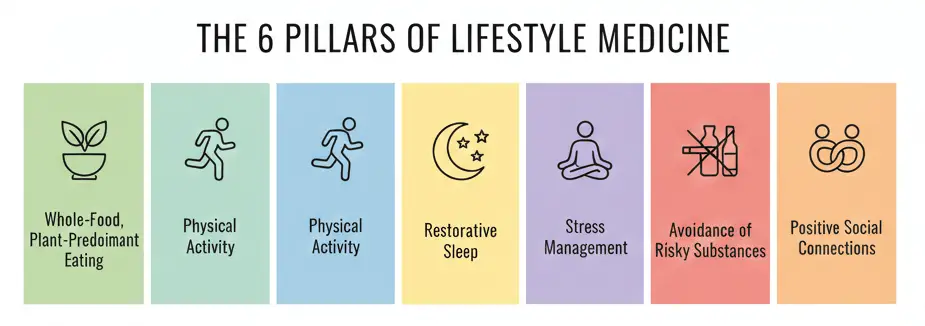
The whole discipline of Lifestyle Medicine revolves around six pillars that are evidence-based and foundational for health creation and maintenance:
- Whole-food, Plant-predominant Eating: A diet that highlights and includes plant-based foods that are less processed.
- Physical Activity: Movement done regularly as a means to achieve health and longevity.
- Restorative Sleep: Giving sleep the importance of quality and duration.
- Stress Management: Practicing meditation and mindfulness as techniques to reduce stress.
- Avoidance of Risky Substances: Stopping or cutting down the use of tobacco, alcoholic beverages, and illegal drugs to the point of not being a risk anymore.
- Positive Social Connections: Fostering relationships that provide support.
Unlock the Power of Six Pillars:
The foundations of lifelong health, wellness, and longevity.
Learn more about each pillar.
The Historical and Modern Evolution
While Lifestyle Medicine might be perceived as a newer medical specialty—since the ACLM was established in 2004—their nexuses can be traced back even centuries.
Hippocrates, who is usually referred to as the father of medicine, stated: “to stay healthy, one has to avoid over-eating, under-exertion”. He even recommended that doctors to take into account the patient’s environment—their food intake, physical activities, and sleep. The enlightenment of these very old philosophers has been reiterated throughout history.

With the shift of disease burden from acute infectious diseases to chronic disorders in the 21st century, focusing on lifestyles and lifestyle changes became extremely important. A groundbreaking study in 1993 estimated that about 80% of premature mortality in the United States was due to an unhealthy lifestyle. This notion went hand in hand with studies on people with the highest life expectancy.
The Blue Zones research, which studies different societies around the globe with the highest number of centenarians demonstrated that progressively following LM principles (friendly bond with others, natural movement, wise eating, and goal of life) not only prolongs life but also enhances the quality of life.
Validating Evidences:
The Power of LifestyleLifestyle Medicine has its own solid base of proof mostly attached to randomized controlled trials and epidemiological studies:
- Type 2 Diabetes Reversal: The Diabetes Prevention Program randomized clinical trial reported that LM intervention was 58% effective at preventing the progression of prediabetes to type 2 diabetes, compared with just 31% in the metformin-treated group.
- Coronary Artery Disease Reversal: The Lifestyle Heart Trial reported that intensive therapeutic lifestyle change not only prevented but actually reversed the progression of coronary artery disease, with patients having a relative reduction in their average coronary artery stenosis by 7.9% at five years.
- Dietary Impact: A systematic review indicated that 11 million deaths worldwide were linked to dietary risk factors in 2017, thus accentuating the pressing need to alter the human diet. The PREDIMED Study revealed the Mediterranean diet coupled with extra-virgin olive oil or nuts led to a ~30% decline in cardiovascular events.
- Physical Activity and Mortality: The death rate of individuals who walked 10,000 steps or more was found to be almost 70% less compared to those who walked only 2,000 steps or less in a study of over 4,800 people. This reduction is vastly greater than for almost any pharmaceutical treatment available.
- Cognitive Health: The risk of Alzheimer’s dementia was reduced by 60% when 4 or 5 healthy lifestyle factors were adopted as opposed to none or only 1 factor being adopted.
Centered on the 6 Pillars, LM changes the health paradigm from a reactive model based on pills and procedures to a proactive, patient-centered model that employs daily habits as the strongest medicine.
Longevity is More Than Just Living Longer—It’s About Living Better!
Our Learning Center provides the roadmap, resources, and expert guidance you need to thrive
Conclution:
In the end, Lifestyle Medicine is not just a medical specialty, but it is a health philosophy that has been supported by centuries of wisdom and modern science. The shift from reactive symptom management to proactive well-being is achieved by integrating the six pillars: nutrition, movement, sleep, stress mastery, social connection, and substance avoidance.
This patient-centered approach supported by evidence gives power to the patients to unveil their true health potential, thereby not only adding years to their life but also ensuring that every year is lived with a greater quality of life. The health that you are to enjoy in the future depends on your everyday choices; begin with small changes today, and watch how lifestyle proves to be your most powerful medicine.